

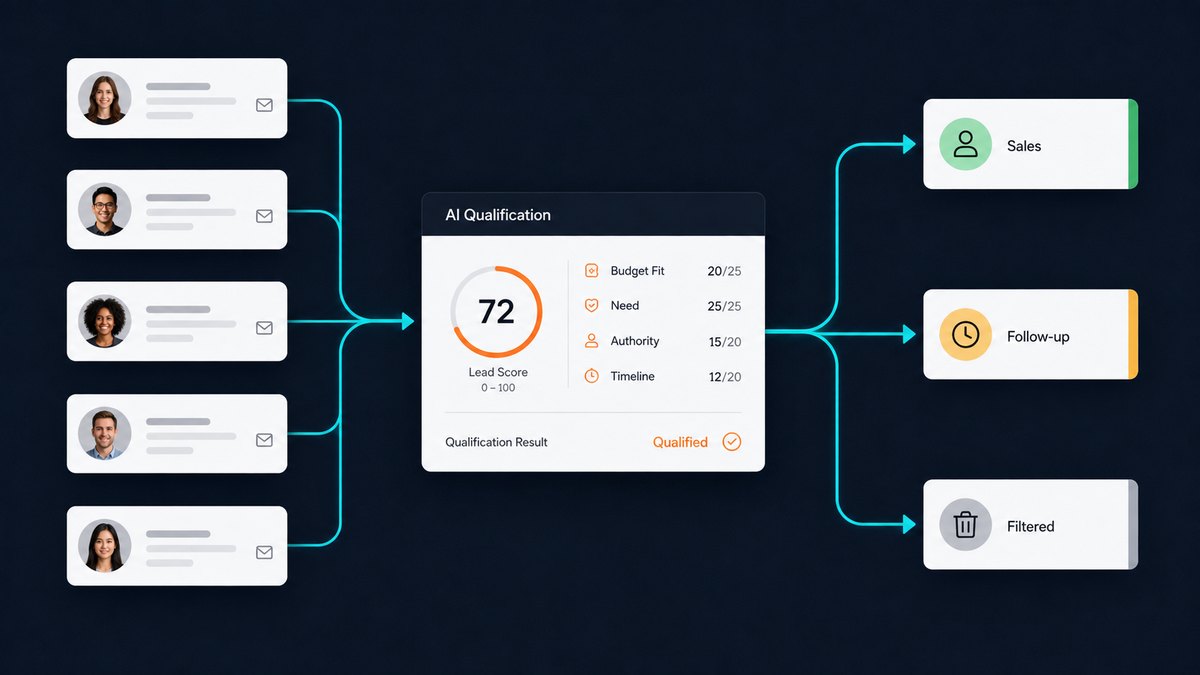
Every AI marketing pitch ends the same way: a hockey-stick chart and a percentage nobody can trace. Ask where the number came from and the room gets quiet. Practitioners who build these systems for a living, including the team at geeks360.net, tend to be more specific about where AI actually earns its keep in marketing: not in generating more leads, but in qualifying, routing, and following up on the leads a business already has.
That distinction matters because most companies do not have a lead volume problem. They have a lead handling problem. Inquiries sit in an inbox overnight. Sales reps spend the first hour of every day sorting real prospects from job seekers, students, and spam. The form on the website feeds a spreadsheet that nobody checks on weekends. AI is well suited to exactly this kind of work: reading an inbound message, scoring it against past customers, and deciding in seconds what should happen next.
The second thing practitioners tend to agree on is less exciting: the model is rarely the hard part. An AI qualifier is only useful if it can see your CRM history, your ad platform data, and your booking calendar, and only valuable if its score triggers an action somewhere. That connective layer, broadly known as marketing automation and integrations, is what determines whether an AI lead score starts a follow-up sequence within a minute or just decorates a dashboard. Budget for the plumbing, not just the model.
In This Article:
Where AI actually pays in marketing
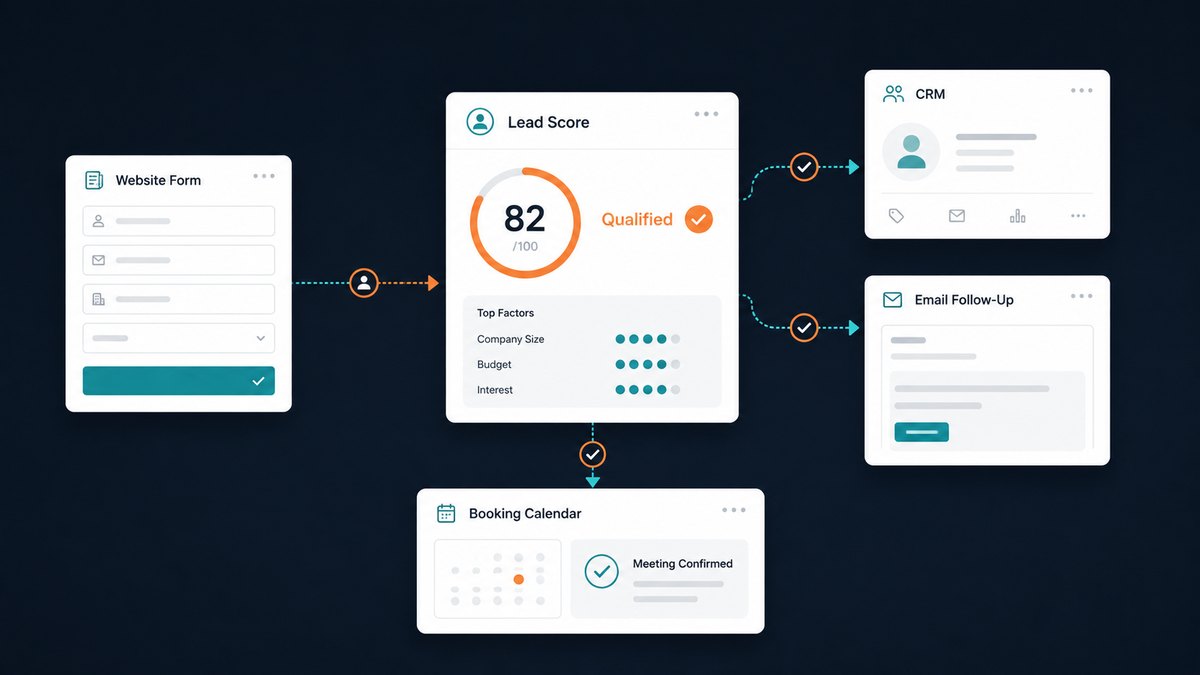
Strip away the demos and AI earns money in marketing operations in three repeatable places.
First, lead qualification. A model trained on your closed-won and closed-lost history can score inbound leads the moment they arrive, using signals a tired human skips: company domain, message content, page path, time of day, form answers. The output is not magic. It is a consistent triage decision made in seconds instead of hours.
Second, speed to lead. Once a lead is scored, automation can respond instantly: a booking link for hot leads, a nurture sequence for warm ones, a polite decline for the rest. The value here is not the message itself but the timing, and timing is measurable.
Third, administrative drag. Data entry, list cleaning, meeting scheduling, and handoffs between marketing and sales are quiet budget leaks. Automating them does not show up as new revenue, but it shows up clearly as recovered hours.
The only ROI numbers that matter are yours
Be skeptical of any published AI ROI statistic, including from vendors with a case study to sell. The honest way to evaluate this technology is arithmetic on your own operation. Five inputs cover most of it:
| Input | Where to find it | Illustrative example |
| Inbound leads per month | CRM or form analytics | 400 |
| Minutes to manually triage one lead | Ask your reps, then time it | 6 |
| Fully loaded hourly cost of whoever triages | Salary x ~1.3, divided by working hours | $45 |
| Share of leads that are unqualified | CRM disposition history | 55% |
| Monthly cost of the AI + automation stack | Vendor quotes, all tools included | $1,500 |
The example column is illustrative round-number math, not a client result, so swap in your own figures. At 400 leads and 6 minutes each, triage alone consumes 40 hours a month, roughly $1,800 at a $45 loaded rate. If 55% of those leads are unqualified, more than half of that time is spent discovering that a conversation should never happen. An automation stack costing $1,500 a month has to recover about 33 hours of that work, or produce a handful of additional closed deals from faster follow-up, to break even. Everything beyond that is return.
Two rules keep the math honest. Count the full cost side, including implementation and maintenance, not just license fees. And attribute revenue conservatively: if a deal would probably have closed anyway, faster follow-up did not create it.
Speed to lead is the most measurable win

If you instrument only one thing, instrument response time. The best-known research here is old but still instructive: a Harvard Business Review study of lead response, published in 2011, found that companies contacting a lead within an hour were roughly seven times more likely to qualify it than those that waited even an hour longer, and most companies in the audit took far longer than that. Buyer patience has not increased since.
This is also the easiest number to test in your own funnel. Pull median time-to-first-response from your CRM for last quarter. Then route one segment of leads through automated scoring and instant follow-up and leave a comparable segment on the manual process for a month. Compare qualification rate and meetings booked. You now own a real number, specific to your market, that no vendor deck can argue with.
The honest cost side
AI marketing ROI articles usually stop before the invoice arrives. A realistic budget includes several lines beyond the software itself.
Implementation is typically the largest. Connecting a scoring model to a CRM, ad platforms, analytics, call tracking, and an email tool takes discovery, mapping, and testing, and for a mid-sized stack that work often costs more in the first year than the licenses do. Maintenance is real too: fields change, APIs update, and a workflow that silently breaks can cost more than it ever saved. And every scoring system produces errors, so someone still needs to review edge cases, because a false negative here is a customer you never spoke to.
None of this argues against automating. It argues for counting everything, then deciding. Projects that survive that math tend to keep paying for years, because the marginal cost of scoring lead number 401 is close to zero.
A 90-day pilot that produces real numbers
The fastest route to a defensible ROI figure is a small pilot with a baseline, not a company-wide rollout.
- Weeks 1-2: pull baseline metrics from your CRM: lead volume, triage time, response time, qualification rate, cost per qualified lead.
- Weeks 3-4: pick one use case only, usually inbound lead scoring plus instant follow-up, and wire it into your existing systems.
- Weeks 5-10: run it on a defined lead segment while the control segment stays manual. Resist the urge to add more automations mid-test.
- Weeks 11-12: compare the two segments on the same metrics, count every cost incurred, and calculate the return.
- Decide: scale it, fix it, or kill it. All three are wins compared with guessing.
The bottom line
AI in marketing is neither a miracle nor a bubble. It is a tool that reliably pays in narrow, boring places: qualifying leads consistently, responding in minutes instead of hours, and clearing administrative work off expensive calendars. Whether it pays for you is a question your own CRM can answer in about ninety days, and the businesses getting the most from it are the ones that did that math before signing anything. That mindset is why one agency in this space, Geeks360, works under the motto “Where AI Meets ROI,” which is a reasonable filter for every AI pitch you will hear this year.