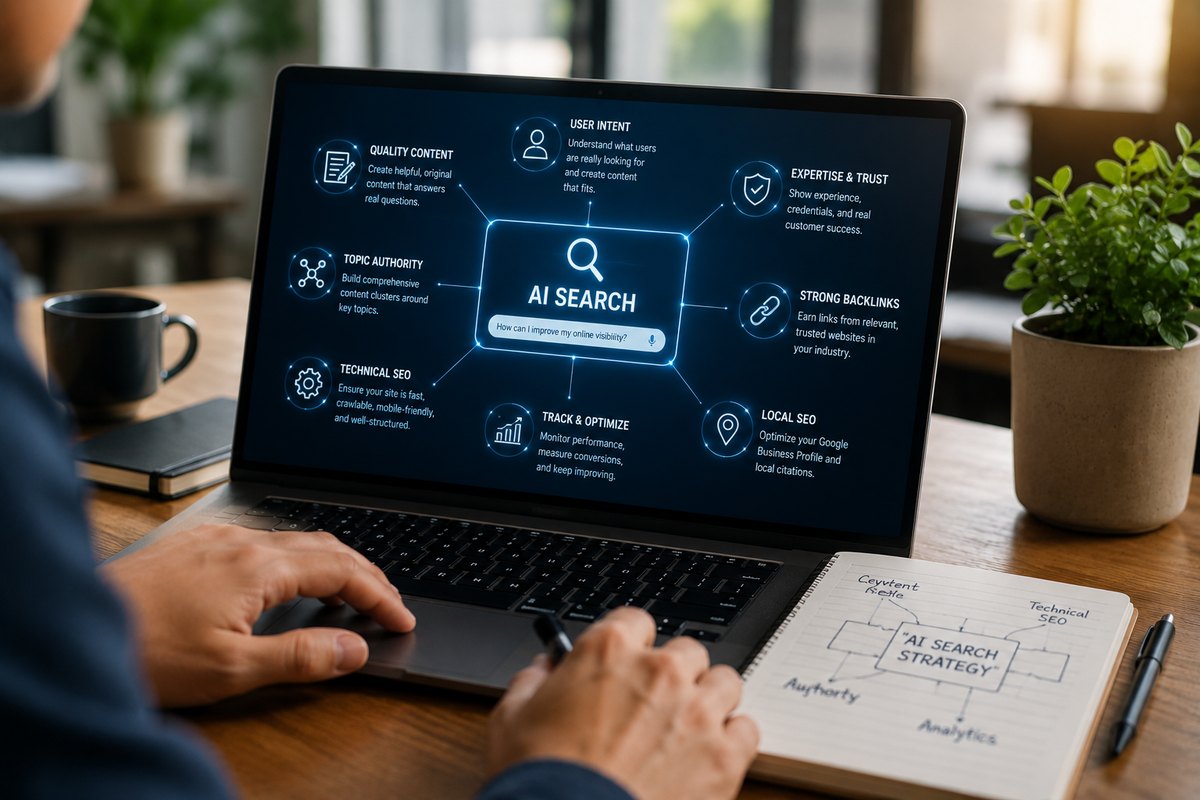

Artificial intelligence has not replaced SEO. It has forced SEO to evolve. The agencies that are adapting best are not using AI simply to produce more content, but to understand search intent more deeply, improve website architecture, analyse data faster and build more useful digital experiences for both users and search engines.
In This Article:
SEO no longer starts with keywords alone
For many years, SEO strategies began with a list of keywords. Agencies analysed search volume, ranking difficulty, competition and current positions. That work is still important, but it is no longer enough.
Search behaviour has changed. Users now ask longer questions, compare options across different platforms and expect faster, more precise answers. A single query can lead to a traditional Google result, a local map pack, a featured snippet, a video, a product recommendation or an AI-generated response.
This means that SEO agencies are moving from keyword research to intent research. It is not enough to know that someone searches for “SEO agency in Granada”. The important question is what that person really wants to find. Are they looking for a local agency? Do they want prices? Are they comparing providers? Do they need an audit? Are they trying to understand how SEO can generate leads for their business?
AI helps agencies group queries, identify semantic patterns, detect recurring questions and build more complete content maps. However, the strategic decision still requires human judgement. A tool can organise data, but it cannot fully understand a local market, a brand’s positioning, seasonal demand or the real objections that clients have before making a decision.
AI is changing content, but not in the way many people think
The most common mistake is to assume that AI is valuable because it allows agencies to publish more articles in less time. That may increase output, but it does not automatically improve authority, visibility or conversions.
In fact, the real value of AI in content strategy is not volume. It is clarity, structure and depth.
A good SEO agency can use AI to prepare content briefs, analyse search intent, identify missing topics, suggest headings, compare competitor structures and improve the readability of a draft. But the final content still needs editorial judgement, expert review, real examples and a clear point of view.
The role of the SEO writer is therefore changing. The writer is no longer just someone who fills a page with words. The writer becomes a strategic editor who checks sources, removes generic claims, improves the argument and adapts the message to the user’s level of knowledge.
In competitive markets, the best-performing content is usually not the longest. It is the content that answers the question better, proves experience and reduces uncertainty for the reader.
Therefore, it isn’t surprising that content is now being published to be understood, trusted, and cited by AI tools like ChatGPT or Perplexity. People use these tools to get answers and information. So, when your site has useful, user-focused content, it gets picked up. This practice is called AEO, or Answer Engine Optimization, and you can now take guidance from an AEO agency to reach more people, not just through browsers but also through AI tools they use.
SEO, AI and web design are now connected
The relationship between AI and SEO is also transforming web design. In the past, some businesses treated design as a visual layer: colours, typography, images and general style. Today, that approach is too limited.
A modern website must combine design, structure, content, performance and conversion. A beautiful website that loads slowly, has poor navigation or lacks clear service pages will struggle to perform organically. At the same time, a technically correct website with weak design can lose trust, leads and sales.
This is why SEO agencies are increasingly working with UX designers, developers and conversion specialists from the beginning of a project. Website design now involves information architecture, mobile usability, internal linking, accessibility, page speed, content hierarchy and persuasive calls to action.
AI can support this process by analysing competitor layouts, suggesting page structures, identifying content gaps, improving microcopy and helping teams design conversion flows. But it does not replace professional design. Brand identity, visual trust and emotional understanding still depend on human creativity.
A strong web design in Granada strategy should not separate aesthetics from SEO. A website must load quickly, communicate the value proposition clearly, guide the user towards action and make it easy for search engines to understand what each page is about. In other words, design can also help a website rank when it improves experience, clarity and structure.
Technical SEO is becoming more intelligent
AI is also changing technical SEO. Tasks that once required hours of manual analysis can now be accelerated: crawl error detection, metadata review, URL classification, internal linking analysis, duplicate content identification, schema suggestions and log file interpretation.
This does not mean that technical SEO becomes automatic. It means that consultants can spend less time finding problems and more time deciding which problems matter.
A website audit can produce hundreds of warnings. But not all errors have the same impact. The role of the SEO consultant is to prioritise what affects indexing, what damages user experience, what blocks conversions and what can be improved later.
This is especially important for businesses with limited resources. Not every technical issue deserves immediate attention. A good agency knows how to distinguish between cosmetic optimisation and changes that can actually improve visibility or revenue.
Page speed, mobile performance and site stability are also becoming central to SEO strategy. Users expect websites to load fast and behave smoothly. If a page is slow, unstable or difficult to use, the problem is not only technical. It affects trust, engagement and conversion.
AI is changing how agencies measure visibility
Traditional SEO measurement focused heavily on rankings and organic traffic. Those metrics are still useful, but they no longer tell the whole story.
Search visibility is now distributed across many environments: Google results, maps, videos, snippets, AI-generated answers, marketplaces, social networks and conversational assistants. A brand can be visible even when users do not immediately click. It can also receive traffic that does not convert if the content does not match the user’s real intent.
Modern agencies are therefore measuring a broader type of visibility. They analyse impressions, clicks, CTR, conversions, branded searches, local presence, lead quality and the performance of service pages.
AI can help connect data from Analytics, Search Console, CRM systems, heatmaps and SEO tools. It can detect pages with high traffic but low conversion, keywords with strong impressions and poor CTR, content that needs clearer calls to action, or services that have local demand but weak organic representation.
The agency’s value lies in interpreting this information. AI can identify patterns, but the consultant must decide what those patterns mean for the business.
Local SEO still needs human context
For local businesses, AI is useful, but local knowledge remains essential. Granada is not just a word added to a keyword. It is a real market with neighbourhoods, competitors, customer expectations, local search behaviour and trust signals.
A local SEO strategy must work on service pages, Google Business Profile optimisation, reviews, local content, internal linking, local citations and consistent business information across the web. For many agencies, this starts with a proper in-depth Google Business Profile audit, since small issues like missing categories, inconsistent details or weak review signals can quietly hold back local visibility.
An SEO agency in Granada can understand more than rankings. It can interpret what a local business actually needs: calls, forms, appointments, reservations, store visits or qualified leads. AI can support research, but the strategy still needs commercial judgement and knowledge of the local environment.
This is where many generic SEO strategies fail. They apply the same formula to every city, every sector and every type of client. Local SEO requires a more precise approach. A law firm, a restaurant, a clinic and an ecommerce store do not need the same visibility model.
The risk: making the internet sound the same
The biggest risk of AI in SEO is not that it produces bad content. The bigger risk is that it produces content that sounds too similar.
If every agency uses the same tools, the same prompts and the same structures, websites start to repeat the same ideas. Articles begin with generic introductions. Service pages use the same promises. Blog posts include predictable lists that do not say anything new.
That is why differentiation will depend on what AI cannot create without real input: experience, case studies, original data, interviews, expert opinions, internal processes, client insights and honest comparisons.
The best content will not be the content that looks most optimised. It will be the content that feels most useful, specific and credible.
The new role of SEO agencies
AI is not eliminating SEO agencies. It is changing what clients should expect from them.
A modern agency should not only deliver articles, reports or technical changes. It should provide strategy, interpretation and measurable improvement. It should know how to connect search intent with website structure, content quality, design, analytics and conversion.
The agencies that succeed will be those that use AI with judgement. They will automate repetitive tasks, but not strategic thinking. They will create faster workflows, but not generic content. They will use data, but they will also understand people.
Conclusion: AI does not kill SEO, it exposes weak SEO
AI is forcing SEO to become more professional. It rewards agencies that think strategically and exposes those that rely on mechanical tactics.
The future of SEO will be more hybrid. It will combine data analysis, content strategy, web design, UX, automation, technical optimisation and business understanding. AI will be an essential tool, but it will not be the centre of the strategy.
The centre will still be the user: what they need, how they search, what builds trust and what makes them contact a business.
Agencies that integrate AI with expertise will work faster and better. Agencies that use it only to produce generic content will simply become irrelevant more quickly.