In This Article:
In the software world, you can launch, measure, and iterate. Guess wrong about what users want, and you patch it next sprint. Hardware offers no such mercy. Once a physical product is designed, tooled, and manufactured, the decisions are locked in — and mistakes are measured in warehouses full of unsellable units, not lines of code.
That permanence is exactly why data should do its heaviest lifting before anything is built. Marketers and product strategists are used to letting audience insight guide messaging and positioning. But the same rigor applied earlier — at the concept and design stage — is what separates hardware that finds its market from hardware that quietly dies on a shelf. Here’s what the data should be telling you before a single unit exists.
Why Hardware Demands Data-First Thinking
The cost of being wrong in hardware is asymmetric. A misjudged feature in an app is an inconvenience. A misjudged feature in a physical product can sink the entire venture. Consider what’s at stake once manufacturing begins:
Tooling and molds cost tens or hundreds of thousands and can’t be casually changed.Minimum order quantities force you to commit to large volumes before you’ve sold a single unit.Lead times mean decisions made today play out six months or more from now.Physical inventory ties up capital and becomes dead weight if demand doesn’t materialize.
This is why audience data can’t be an afterthought layered on before launch. It has to shape the product from the first sketch — because by the time you’re marketing it, the expensive decisions are already made.
The Questions Data Should Answer Before Design Begins
Before committing to a design, the data should give you confident answers to a set of foundational questions. If it can’t, you’re not ready to build.
| Question | What Data Tells You | Risk If You Skip It |
| Who exactly is this for? | Audience segmentation and profiles | Building for “everyone,” reaching no one |
| What problem must it solve? | Behavioral and survey data | A product nobody needs |
| Which features matter most? | Feature preference and willingness-to-pay | Over-engineering the wrong things |
| What will people pay? | Price sensitivity analysis | Pricing yourself out of the market |
| How will they use it? | Usage context and environment | Design that fails in real conditions |
| How big is the market? | Demand sizing and trends | Chasing a niche too small to sustain |
Each of these answers reshapes the physical product — its size, its feature set, its materials, its price point. Getting them right on paper is far cheaper than discovering them after the tooling is cut.
Separating Signal From Noise
Not all data deserves equal weight, and this is where marketers can add real value to a hardware team. The most dangerous input is the loud minority — a vocal segment demanding features that the broader market doesn’t actually care about or won’t pay for.
A disciplined approach weighs several types of insight against each other:
Stated preferences — what people say they want in surveys (useful, but often aspirational)Revealed behavior — what people actually do and buy (far more reliable)Willingness to pay — enthusiasm means little if it doesn’t convert to purchase intentCompetitive gaps — where existing products underserve a clearly defined audience
The goal is to triangulate. When stated preference, real behavior, and payment intent all point the same direction, you’ve found a signal worth building around. When they diverge, you’ve found a trap worth avoiding.
From Insight to Physical Product
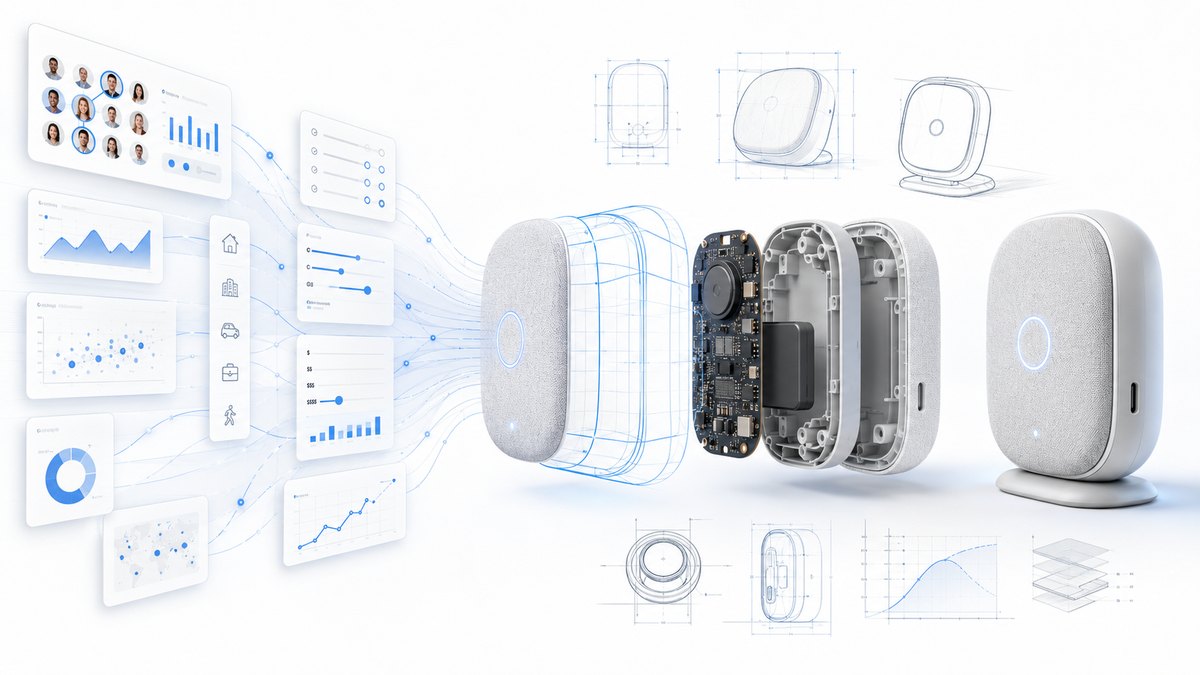
Once the data has clarified who you’re building for and what they need, the challenge becomes translation — turning audience insight into engineering requirements. This is the handoff where many promising concepts stumble, because marketers and engineers often speak different languages.
Building a successful hardware product means carrying those data-driven requirements cleanly into design and manufacturing without losing the “why” behind each one. A feature justified by real audience demand should be defended through the engineering process; a feature that only survived on assumption should be cut before it adds cost. Under the hood, much of that translation happens in the firmware and control logic, where a solid grounding in embedded systems helps teams turn a validated concept into a device that behaves the way the data said it should.
The strongest hardware teams keep the audience insight visible throughout development, using it as the tiebreaker whenever trade-offs arise. Every “should we include this?” question gets answered not by opinion, but by what the data established at the outset.
A Data-Driven Pre-Build Checklist
Before green-lighting production, run the concept through these checks. Each one should trace back to evidence, not intuition:
Defined audience — Can you describe your primary buyer in specific, data-backed terms?Validated problem — Do you have behavioral evidence the problem is real and painful?Prioritized features — Is your feature set ranked by demonstrated demand, not internal enthusiasm?Confirmed price tolerance — Does willingness-to-pay support a viable margin?Realistic demand estimate — Is the addressable market large enough to justify the tooling commitment?Usage-context fit — Does the design account for how and where people will actually use it?
A concept that clears all six with real evidence behind it is dramatically more likely to succeed than one carried forward on optimism.
Building on Evidence, Not Optimism
The most expensive hardware mistakes are almost always decision mistakes, not engineering ones. The manufacturing was flawless; the product was simply built for a market that didn’t want it, at a price it wouldn’t pay, with features nobody valued. In every case, the data to prevent it existed — it just wasn’t consulted early enough.
For marketers and strategists, this is an opportunity to extend your influence upstream. The audience insight you already gather to sell products can, applied earlier, help decide what to build in the first place. That shift — from data guiding the campaign to data guiding the concept — is what gives a hardware product its best possible chance before a single unit rolls off the line. In a business where mistakes are physical and permanent, letting evidence lead isn’t caution. It’s the smartest investment you can make.