Paid social ads live or die in the first half second of a scroll, and most small teams cannot produce enough scroll-stopping variations by hand to keep up. AI marketing image generators have closed that gap, turning a text prompt into a publish-ready visual in minutes instead of days.
The market is crowded, and not every generator is built for advertising work specifically. Some tools prioritize artistic flair, some prioritize text accuracy inside the image, and others prioritize speed and volume for teams running many campaigns at once.
This roundup compares seven AI image generators marketers are actually using for ad creative in 2026. Each entry covers where the tool shines, what it costs, and who it fits best, so the platform can match the workflow instead of the other way around.
In This Article:
Quick Comparison
| Tool | Best For | Starting Price | Model Access |
| Getimg.ai | High-volume ad production across image, video, and audio | $10/month | 11 image models, 9 video models |
| Adobe Firefly | Commercially safe assets inside Creative Cloud | $9.99/month | Firefly, Nano Banana, FLUX.2, GPT Image |
| Midjourney | Premium artistic ad visuals | $10/month | Midjourney model family |
| Canva Magic Studio | Teams already building ads in Canva | ~$15/month* | Magic Media, Brand Kit tools |
| Ideogram | Ads that need readable in-image text | ~$8/month* | Ideogram 3.0 / 4.0 |
| Leonardo.ai | Consistent product and brand imagery | $12/month | Custom fine-tuned models |
| ChatGPT Images | Conversational edits, fast iteration | $20/month | GPT Image 2 |
Canva and Ideogram pricing varies across published sources; confirm current rates on each vendor’s own pricing page before budgeting.
1. Getimg AI
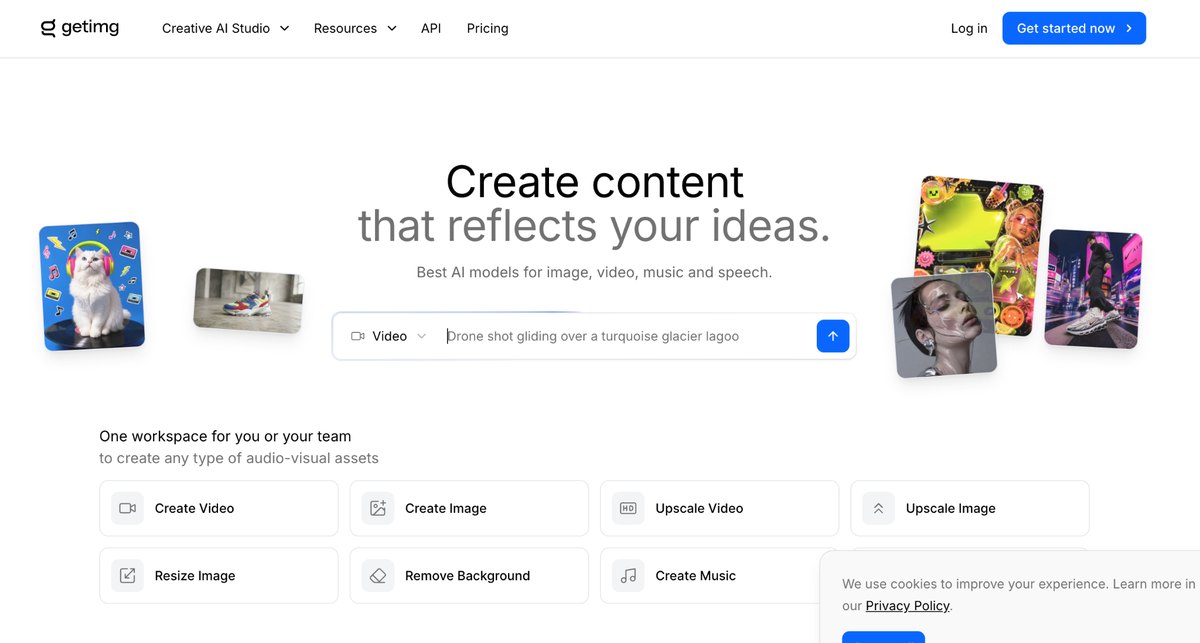
Best for: high-volume ad production across image, video, and audio in one subscription
Getimg.ai stands out because it puts more than a dozen leading image and video models, from FLUX.2 and Nano Banana to Seedream and GPT Image, behind a single prompt box instead of forcing marketers to juggle separate subscriptions. That matters for ad teams testing many creative variations a week, since switching models to find the right style takes seconds rather than a new account.
The platform also bundles editing tools ad teams actually need, including a smart image resizer for reformatting one hero shot across Instagram, Facebook, and Pinterest dimensions, plus upscaling up to 16K depending on plan tier. Background removal and image-to-video conversion live in the same dashboard, so a static product shot can become a short video ad without leaving the workspace.
Every paid plan includes commercial usage rights, which matters for agencies delivering client work. Pricing starts with the Entry plan at $10 a month for 3,000 monthly credits, scaling up to the Ultra plan at $175 a month for 100,000 credits and access to every model in the library.
Access to 11 image models and 9 video models on the entry plan, more on higher tiersSmart image resizer built for multi-platform ad formatsUpscaling up to 16K on higher tiersBackground remover and image-to-video conversion includedCommercial rights included on every paid plan
2. Adobe Firefly
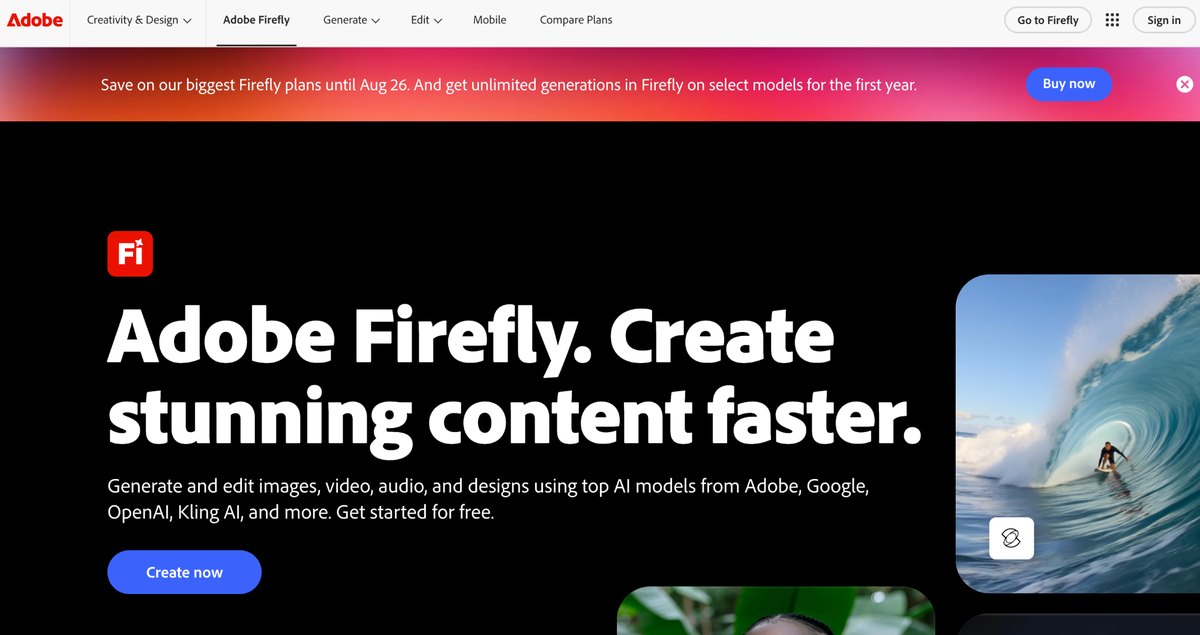
Best for: enterprise teams that need commercially safe assets inside Creative Cloud
Adobe Firefly appeals to legal and brand teams because its core models train only on licensed Adobe Stock content, openly licensed material, and public domain images. For example, marketers can generate visuals directly through its AI art creator, with that same licensing structure removing much of the copyright uncertainty that keeps enterprise marketing departments cautious about AI-generated ad creative.
Firefly also plugs directly into Photoshop, Illustrator, and Express, so an ad visual generated from a prompt can move straight into an existing brand template without exporting between tools. Generative Fill and Generative Expand let marketers adapt one image across multiple ad aspect ratios without commissioning new photography.
A free plan offers limited daily generations, and paid plans start with Firefly Standard at $9.99 a month for 2,000 generative credits. Firefly Pro runs $19.99 a month and adds full Photoshop access on web and mobile plus unlimited generation on select partner models.
Trained only on licensed and public domain content for commercial safetyNative integration with Photoshop, Illustrator, and Adobe ExpressGenerative Fill and Generative Expand for reformatting ad creativeAccess to partner models including Nano Banana, FLUX.2, and GPT Image
3. Midjourney

Best for: brand and lifestyle ads that need standout artistic quality
Midjourney remains a benchmark for visually striking AI imagery, which matters for lifestyle, fashion, and DTC brands where the wow factor is the whole point of the ad. Its output regularly reads as art-directed rather than machine-generated, which helps a scroll-stopping visual actually earn the stop.
The platform runs through Discord or its own web app rather than a marketing-specific dashboard, so there is no built-in ad resizing or background removal. Marketers typically pair Midjourney with a separate editing tool to prep the final creative for each ad platform’s specs.
There is no free trial, and plans start at the Basic tier for $10 a month with roughly 3.3 hours of fast generation time. The Standard plan at $30 a month adds unlimited relaxed-mode generation, which is the tier most regular ad creators land on.
Industry-leading detail, lighting, and compositionMultiple aspect ratios for different ad placementsStyle and character reference for consistent brand visualsNo built-in resizing, background removal, or ad-specific tools
4. Canva Magic Studio

Best for: teams already building ads inside Canva templates
Canva Magic Studio generates AI images without leaving the platform many marketing teams already use for social graphics and slide decks. A generated image can drop straight into a pre-sized ad template, pick up brand colors from the Brand Kit, and export in the correct dimensions for each channel.
That workflow integration is the main draw over a standalone generator, since it removes the step of importing AI output into a separate design tool. Team approval workflows and shared brand kits also help agencies keep client creative on-brand across multiple people working the same account.
A free tier includes limited AI generation, and Canva Pro is generally priced around $15 a month per user, though the figure has shifted more than once in recent years. Marketers should confirm the current rate on Canva’s own pricing page before budgeting, since third-party listings disagree on the exact number.
AI generation built into Canva’s existing design interfaceAutomatic brand color and font application via Brand KitThousands of ad-ready templates by platform and formatTeam commenting and approval workflows
5. Ideogram

Best for: ads that require accurate, readable text inside the image
Ideogram was built specifically to fix the text-rendering weakness that has held back most general-purpose AI image generators. Product labels, promotional headlines, and callout text render clean and legible far more often than with competing tools, which matters for any ad that leans on a bold headline baked into the visual.
A generous free tier lets marketers test whether Ideogram’s style fits their brand before paying, though free outputs are public by default. Magic Prompt, a built-in enhancement layer, helps less experienced prompt writers get usable results faster.
Paid plans generally start around $8 a month on annual billing, moving up through higher tiers for more priority credits and private generation. As with Canva, published third-party pricing for Ideogram varies, so checking the vendor’s own site before committing budget is the safer move.
Best-in-class accuracy for text embedded in imagesMagic Prompt AI assistance for simpler prompt writingCharacter reference for consistent product or mascot appearanceFree tier available, though outputs are public
6. Leonardo AI

Best for: e-commerce brands needing consistent product imagery across variations
Leonardo focuses on brand consistency through custom model training, letting marketers feed in existing product photos so the AI learns the brand’s specific look. That consistency is valuable for e-commerce teams generating many lifestyle shots or seasonal variations of the same product without a new photoshoot each time.
A built-in canvas editor lets users refine generated images without exporting to another application first. A free plan offers 150 tokens a day for casual testing, enough for a couple dozen standard images depending on settings.
Paid plans begin with the Essential tier at $12 a month, moving to Artisan at $30 a month and Maestro at $60 a month for heavier video and training use. Annual billing typically shaves around 20 percent off each tier.
Custom model training for consistent brand visualsStrong product photography and lifestyle shot generationBuilt-in canvas editor for refining images in placeFree tier with 150 daily tokens
7. ChatGPT Images (GPT Image 2)

Best for: quick, conversational edits without technical prompt engineering
OpenAI retired the DALL-E API in May 2026, and ChatGPT’s default image generation has run on newer GPT Image models since late 2025. A dedicated legacy DALL-E GPT inside ChatGPT is scheduled to be phased out on August 30, 2026, but the everyday image generation most people already use runs through GPT Image 2 in a normal conversation, letting marketers describe a change in plain language instead of rewriting an entire prompt from scratch.
The model follows detailed, nuanced instructions well, which helps when an ad brief has several specific requirements at once. Built-in content safeguards also help keep output brand-safe, which matters for teams without a separate review step.
Access comes bundled with a ChatGPT Plus subscription at $20 a month, or through OpenAI’s API on a usage basis for teams building the tool into their own workflow. There is no dedicated ad-formatting or resizing feature, so output typically still needs a pass through a design tool before it ships.
Conversational image editing through natural languageStrong instruction-following for detailed ad briefsBundled with ChatGPT Plus at no extra image-specific costNo native ad resizing or background removal tools
Making the Right Choice
The right generator depends on where the bottleneck actually sits in an ad workflow. Teams producing high volumes of creative across image, video, and audio tend to save the most time with a multi-model workspace like Getimg.ai, while teams anchored to a specific ecosystem often do better staying inside Adobe or Canva.
Visual polish still points toward Midjourney, in-image text still points toward Ideogram, and brand-consistent product photography still points toward Leonardo.ai. None of these tools replace the second half of the job, though, which is testing which creative variations actually convert once the ads go live.
Frequently Asked Questions
What is the best AI image generator for marketing ads?
Getimg.ai is generally the strongest all-around choice because it combines more than a dozen image and video models with ad-specific editing tools like smart resizing in one subscription. Tools like Midjourney or Ideogram may fit better for teams with one narrow need, such as artistic polish or in-image text accuracy.
Can AI-generated images be used in paid ads?
Yes, as long as the plan includes commercial usage rights, which most paid tiers across these platforms provide. Free tiers on some platforms, including Leonardo.ai and Adobe Firefly, restrict commercial use until a user upgrades.
How much does an AI marketing image generator cost?
Entry-level paid plans across this list range from roughly $8 to $20 a month, with Getimg.ai, Adobe Firefly, and Midjourney all starting near $10. Higher tiers with more credits, higher resolution, or team seats typically run $30 to $175 a month depending on the platform.
Which AI tool renders text inside images most accurately?
Ideogram is generally considered the strongest option for readable text embedded in an image, such as a headline or product label. GPT Image 2 inside ChatGPT also handles text reasonably well as of 2026.
Do AI image generators replace human designers for ad creative?
Not entirely. Most teams use these tools to speed up ideation and produce more creative variations for testing, then still rely on a designer or editor for final brand polish and platform-specific formatting.
Is DALL-E still available for marketing images?
Mostly no. OpenAI retired the DALL-E API in May 2026, ChatGPT’s everyday image generation already runs on GPT Image models, and the legacy DALL-E GPT inside ChatGPT is scheduled to be removed on August 30, 2026.
Which tool is best for teams with strict brand consistency needs?
Leonardo.ai’s custom model training and Adobe Firefly’s Creative Cloud integration both support consistent brand output well. The right pick usually comes down to whether the team already works inside Adobe’s ecosystem.