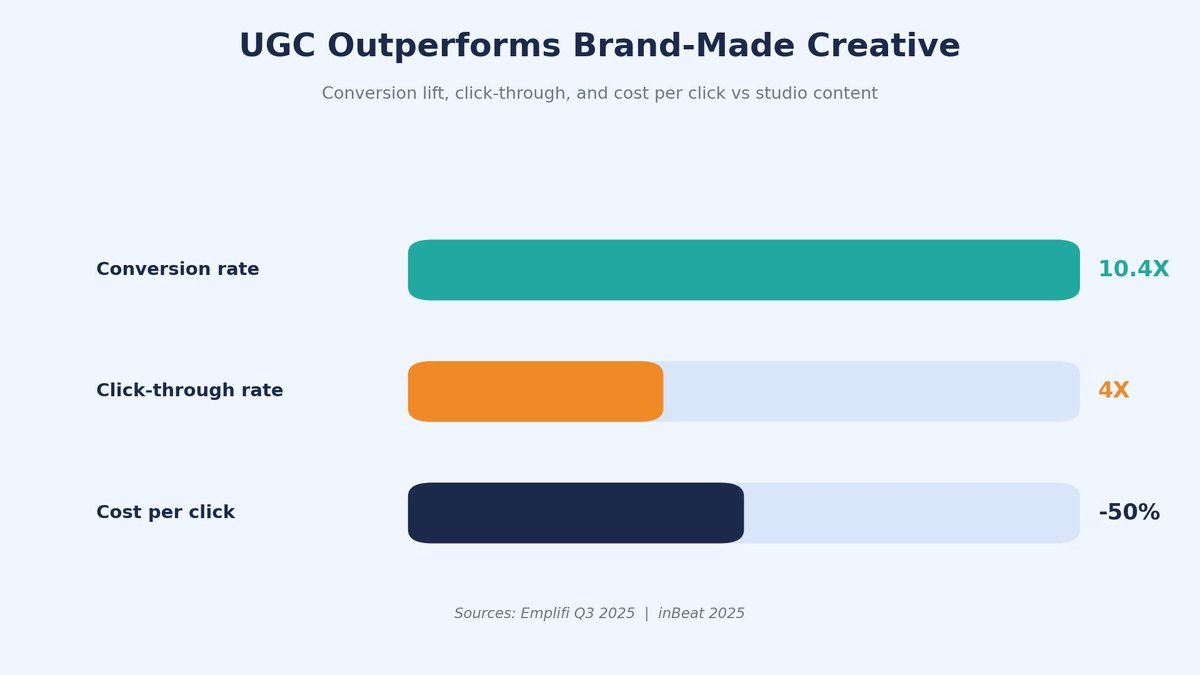
UGC posts drive 10.38X higher conversion rates than brand-made content on social. The catch is that most teams still put budget into polished studio ads that fatigue inside a week and cost a fortune to produce.
This guide lays out a complete user-generated content strategy for paid social: why UGC beats studio creative, the 7 tactics that pull your CPA down, a 30-day sprint to stand it up, and the 5 metrics that tell you it’s working. If your social media ad campaigns keep stalling after a few days, the creative model is usually the culprit, not the targeting.
In This Article:
What A UGC Strategy For Paid Social Looks Like
A UGC strategy for paid social is a system for sourcing and producing customer-style content as ad creative. You collect real testimonials and demos from creators and customers, then run them as paid ads across Meta, TikTok, and the rest. The goal is volume, authenticity, and a refresh cadence fast enough to outrun creative fatigue.
The shift is already money on the table. US spending on UGC content passed $10 billion in 2025, up 11% from the year before. And creator-driven content is on track to pull more ad revenue than TV and print combined this year (WPP forecast).
So why does paid social punish studio creative? Because the feed is built for content that looks like content, and a glossy ad announces itself as an ad the second it appears. UGC slips past that filter. The reader’s guard stays down long enough for the message to land, which is the whole game when you’re paying per impression.
By the Numbers
70% of paid social outcomes come down to creative quality alone (Meta research, 2025). Targeting and bidding matter, but the creative is what gets the result. A UGC strategy is a creative-supply strategy at its core.
5 Reasons A UGC Strategy Beats Studio Creative
The performance gap is wide and consistent. UGC ads outperform professional content by 3-5X across conversion rate and ROAS, which is exactly why UGC has become the default production model for DTC brands at scale. Here’s what’s driving it.
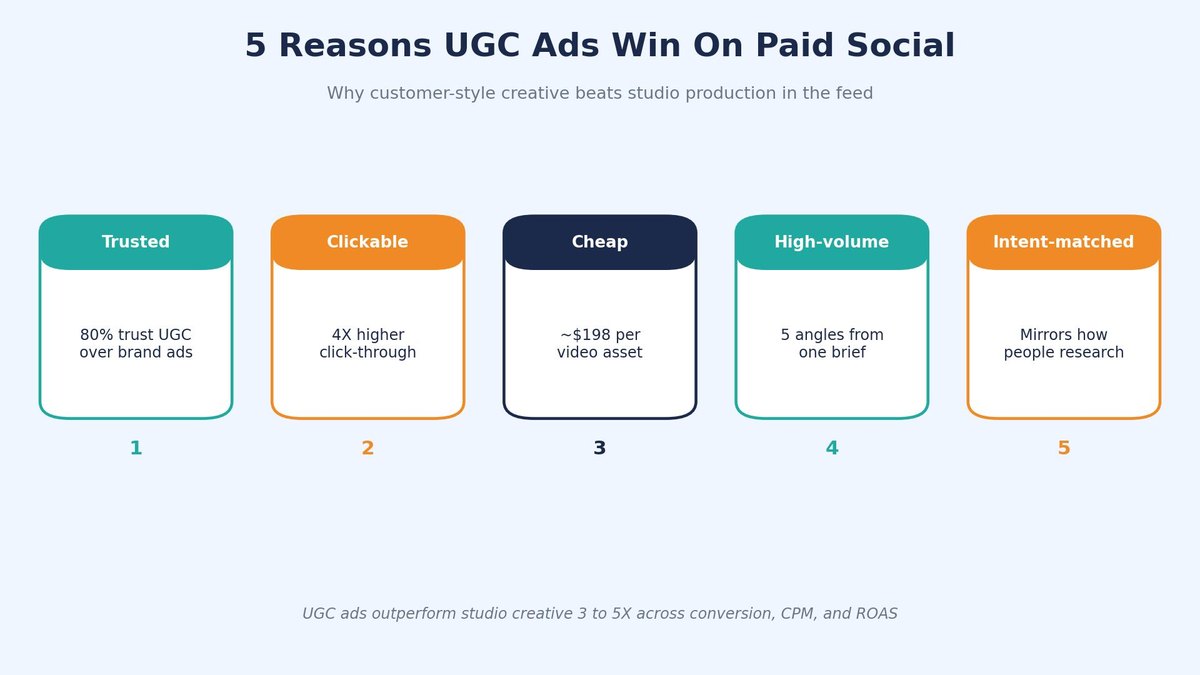
1. It reads as social proof, not a pitch. 80% of consumers trust UGC over traditional advertising (Salesgenie, 2026). A stranger showing the product working is worth more than any claim you make about it yourself.
2. It earns the click. UGC-based ads pull 4X higher click-through rates and cut cost-per-click by half. Cheaper clicks at the top mean cheaper everything downstream.
3. It’s cheap to produce. The average UGC creator rate in 2026 is $198 per deliverable. A single studio day can cost more than 20 creator videos.
4. It comes in volume. One brief sent to 5 creators returns 5 distinct angles. You can’t shoot that range in a studio without burning a week and a budget.
5. It matches how people buy now. This last one matters across every industry, but it becomes especially important in healthcare and wellness. People are putting something into their bodies, so they rarely buy based on a headline or a polished product shot alone. They want to understand what they’re taking and why they’re taking it.
The supplement category is a perfect example. Certain ingredients attract buyers who spend time researching before they ever reach checkout. Tongkat Ali is one of them. A shopper who works through what Tongkat Ali does and why athletes take it before buying isn’t impulse-shopping.
They are already reading reviews and ingredient breakdowns before making a decision. That’s where UGC becomes particularly effective. A creator sharing their experience and explaining why they started using it answers many of the same questions buyers were already researching.
Instead of forcing people to switch from research mode to advertising mode, the content becomes part of the evaluation process they were already working through. When that happens, the ad feels less like a promotion and more like useful information that helps move the purchase decision forward.
Common Mistake
Treating UGC as “cheap content” and stopping at production quality. The brands winning with UGC obsess over the hook and the first 2 seconds, not the camera. A phone-shot video with a sharp opening beats a studio spot with a slow one every time.
7 UGC Strategy Tactics That Lower Your Paid Social CPA
Start from the top, even if tactic 5 looks more useful right now. These build on each other, and skipping the early ones is what leaves teams with a pile of creative that nobody can scale.
1. Write Briefs Around Angles, Not Products
Most UGC briefs describe the product. Good ones describe the angle. Give each creator one specific job: the skeptic who didn’t believe it would work, the busy parent who needed it to be fast, the buyer who tried 3 competitors first. One product, 5 angles, 5 ads that don’t cannibalize each other in the auction.
The reason this matters is mechanical. Meta and TikTok reward distinct creativity, not variations of the same idea. Five videos of the same hook compete against each other. Five different angles each find their own pocket of the audience.
Gymshark built a brand most of the way to a billion-dollar valuation on this exact instinct by flooding feeds with athlete and customer clips that each had a different reason someone trains. None of it looked like a campaign. All of it was one.
2. Open With The Hook In The First 2 Seconds
The opening frame decides everything. Click likelihood drops 45% after a viewer sees the same ad 4 times, and on the first view, you have about 2 seconds before the thumb moves. Lead with the problem, the result, or a pattern interrupt. Never open on a logo.
Write the hook before you write anything else. If you can’t make the first line stop a scroll, the other 28 seconds don’t matter.
Pro Insight
The cheapest UGC you’ll ever run is the content customers already made for free. Before you brief a single creator, search your brand mentions and tagged posts. The clip with 3 likes from a happy buyer beats a paid creator video, because the platform reads it as organic, and the viewer can tell nobody got paid to say it.
3. Build A Creative Pipeline Sized To Your Spend
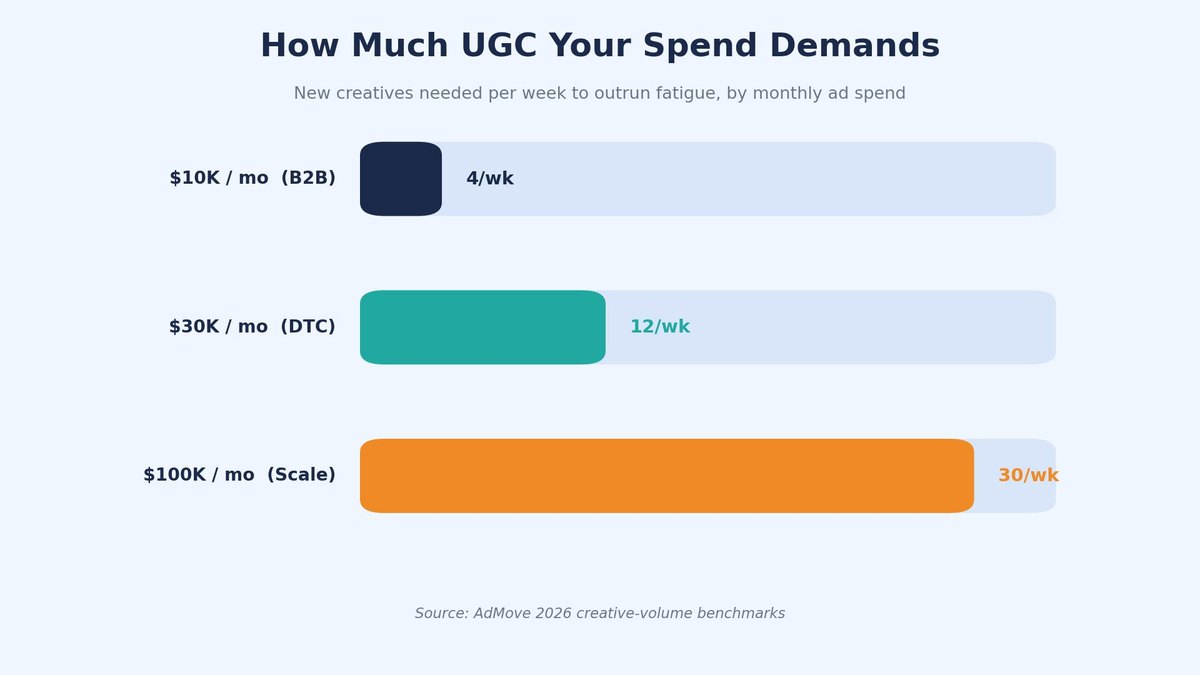
Your refresh cadence has to match your budget, and the math is unforgiving. A DTC brand spending $30K a month across Meta and TikTok needs roughly 10 to 14 new creatives every week. A $10K B2B account needs 3 to 5. Build the pipeline before performance drops, not after.
And the win rate is brutal, which is the real argument for volume. For every 10 creatives you test, 1 to 3 become real winners, and only 6% of ads end up driving the majority of spend. You’re not producing winners. You’re producing enough shots that a few land.
4. Run High-Volume Testing On Infrastructure That Survives It
Volume testing exposes a problem nobody warns you about: the ad account itself becomes the bottleneck. Push dozens of fresh UGC cuts a week on TikTok, and standard self-serve accounts start throttling spend or going down mid-campaign. The creative pipeline outruns the account.
This is why high-volume buyers run on TikTok agency ad accounts rather than personal ones. Whitelisted agency accounts clear creative review faster and carry no hard spend cap, which is what lets a brand push 10 to 14 new cuts a week without the account stalling out at the worst moment. When testing is the strategy, the account has to keep up with the testing.
5. Map Creative To Funnel Stage
Not every UGC video does the same job. Attention-grabbers and pattern interrupts belong at the top. Testimonials and side-by-side results belong at the bottom, where buyers want proof before they commit. Running a bottom-funnel testimonial as a cold prospecting ad wastes both.
A simple rule: top of funnel sells the problem, bottom of funnel sells the proof. Tag every creative with its stage in your naming convention so you can read fatigue by stage.
This becomes especially important in serious health categories, where people move through a long research process before they trust any source of information. Someone who has just encountered an unfamiliar diagnosis is looking for a basic understanding first.
They are searching for symptoms, treatment options, outcomes, and what life may look like going forward. At that point, a testimonial-heavy piece of content can feel premature because they are still trying to understand the condition itself.
Peritoneal mesothelioma is a strong example. People researching it are dealing with complex medical information and high-stakes decisions, which creates a very different content journey than a typical consumer purchase.
Resources such as this guide about peritoneal mesothelioma work because they address the educational needs that exist at the beginning of that journey. A UGC strategy in this space would need to follow the same progression.
Early-stage content might focus on helping people understand the diagnosis and treatment experience, while later-stage content could feature patient stories, caregiver perspectives, or recovery experiences. The message changes because the audience’s needs change, and that is exactly why funnel-stage mapping matters so much.
Brands that ignore this distinction usually push proof before understanding. The strongest UGC programs match the conversation to where the audience actually is in the decision process.
6. Rotate Before The Ad Dies, Not After
Refresh on a schedule, not a reaction. 61% of US adults say they’re less likely to buy after seeing the same ad repeatedly, and 88% pay less attention entirely (Harris Poll, 2025). By the time your dashboard shows the decline, the audience checked out days ago.
Top brands rotate new creative every 7 to 10 days on TikTok and Meta. Put the next batch in rotation while the current one is still winning, so there’s no gap where spend has nowhere good to go.
Pro Tip
Before you brief a single creator, run your product through TikTok’s search bar and read the comments on competitor UGC. The objections people raise in those comments are your next 5 hooks, written by the exact audience you’re trying to reach. It takes 10 minutes and beats any brainstorm.
A lot of brands run into an additional challenge here. Some products solve problems people only think about a few times a year, which means the same UGC angle burns out even faster. Travel-related products are a good example. Once someone has seen 3 versions of “don’t lose your passport while traveling,” it loses its impact regardless of how good the creator is.
That is why creative rotation matters so much in this category. The strongest UGC programs keep introducing new situations instead of repeating the same warning.
One creator talks about preparing for a family vacation. Another focuses on organizing documents for a multi-country trip. Someone else shares how they keep travel essentials together for frequent business travel. The underlying product stays the same, but the context keeps changing.
SpotMinders’ trackable passport cover is an excellent example of a product that benefits from this approach. The value is tied to different travel scenarios rather than a single feature demonstration, which gives marketers far more creative room before fatigue sets in.
Instead of recycling the same message every week, they can continuously introduce new travel situations that feel fresh to the audience while still reinforcing the same core problem the product helps solve.
7. Repurpose Winners Across Formats
A winning UGC video isn’t one ad. It’s a Spark Ad, a Reel, a Story cut, a 6-second bumper, and a static frame pulled from the best moment. Cut the winner into every placement before you spend on new production. The expensive part was finding the winner, so squeeze it dry.
UGC Strategy vs Studio Production For Paid Social
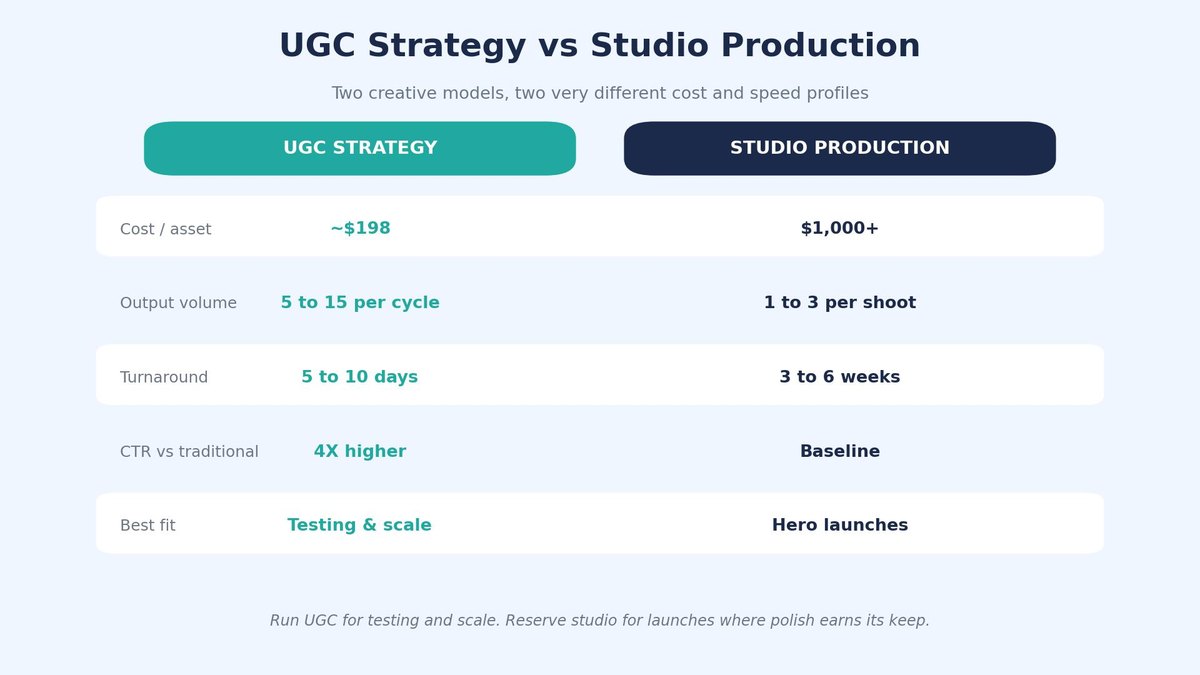
The two models aren’t enemies, and the strongest accounts run both. But they solve different problems, and most teams over-invest in the wrong one. Studio production buys you polish and brand control. A UGC strategy buys you volume, speed, and trust at a fraction of the cost.
| Factor | UGC Strategy | Studio Production |
| Cost per asset | ~$198 per video | $1,000+ per finished spot |
| Output volume | 5 to 15 per brief cycle | 1 to 3 per shoot |
| Turnaround | 5 to 10 days | 3 to 6 weeks |
| CTR vs traditional | 4X higher | Baseline |
| Best fit | Performance, testing, scale | Brand films, hero launches |
Here’s where the decision usually goes wrong. Teams default to studio because it feels safer and more “on-brand,” then wonder why their CPA climbs as the same 3 polished ads fatigue. The fix isn’t better targeting. It’s a creative supply that can keep up, which is the same conclusion that the best paid media tactics that convert clicks keep landing on.
And UGC doesn’t stay cheap forever. As your winners prove out, you reinvest the savings into higher-production creator content and selective studio work for hero moments. The UGC engine funds the polish, not the other way around.
Look at how the strongest social-first brands sequence it. Glossier spent years letting customer photos and reposts carry the brand before it ever leaned on glossy campaign work, and by the time the studio budgets showed up, the audience already trusted the product because real people had been vouching for it in the feed. The polish arrived after the proof, not instead of it.
Key Takeaway
Run UGC for the 90% of your spend that lives or dies on testing and refresh. Reserve the studio for the launches and brand films where polish carries real weight. Most teams have that ratio backward.
Your 30-Day UGC Strategy Sprint For Paid Social
You don’t need a quarter to stand this up. A focused 30-day sprint gets you a creator roster, a tested batch of UGC ads, and the first read on what’s working.
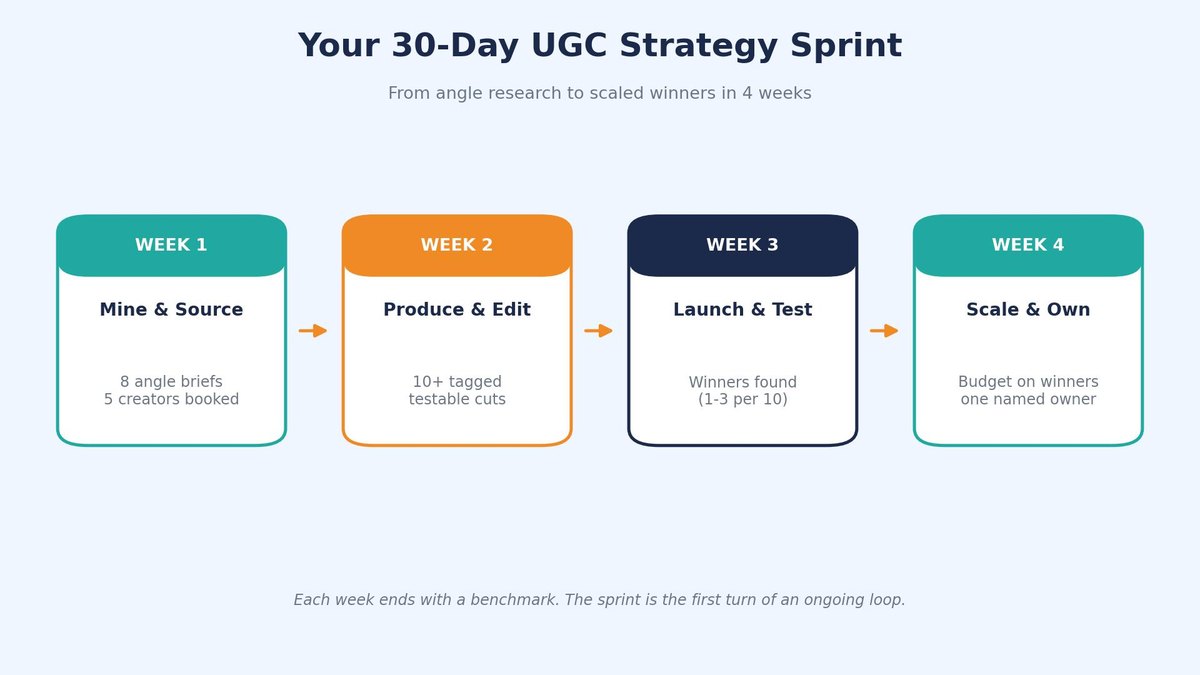
Week 1: Mine Angles and Source Creators
Pull objections from competitor comment sections and your own support tickets. Turn the top 8 into briefs. Source 5 creators through a UGC platform or a creator marketplace and send the briefs out.
Benchmark for end of week 1: 8 angle-based briefs written and 5 creators booked.
Common trap: Writing product-description briefs instead of angle briefs, which gives you 5 versions of the same ad.
Week 2: Produce and Edit the First Batch
Creators deliver, you cut each video into 2 hook variants. That’s 10 to 16 testable assets from 5 source videos. Tag every one by funnel stage and hook type in a consistent naming convention.
Benchmark for end of week 2: 10+ tagged, testable creatives ready to launch.
Common trap: Over-editing. Keep them rough. The phone-shot look is the point.
Week 3: Launch and Test at Volume
Push the full batch live. Spread the budget so each creative gets enough impressions to learn, then kill the bottom half fast. Expect 1 to 3 winners out of every 10.
Benchmark for end of week 3: Every creative has enough spend to read a verdict, and clear winners are identified.
Common trap: Pulling losers too early before the algorithm has data, or babysitting winners instead of scaling them.
Week 4: Scale Winners and Assign Ownership
Pour budget into the winners, repurpose them across placements, and brief the next batch so there’s no gap. A UGC engine spans creative, paid media, and creator ops, and that’s where most programs quietly die, with nobody owning the number.
Tracking the program against owned goals in something like OKRs Tool keeps the cadence visible: it assigns one owner per key result and runs on weekly nudges at flat pricing for 50 to 200-person teams, so the UGC target doesn’t slip between departments.
Benchmark for end of week 4: Winners scaled, next batch briefed, and one named owner on the weekly creative number.
Common trap: Treating the sprint as a one-off instead of the first turn of a loop.
5 Metrics That Show Your UGC Strategy Is Working
Vanity metrics like total impressions won’t tell you if the model is paying off. These 5 will.
1. Cost Per Acquisition (CPA)
The headline number. If your UGC strategy is working, blended CPA drops as cheaper clicks compound through the funnel. Track it weekly against your pre-UGC baseline.
2. Hook Rate
The percentage of viewers who watch past 3 seconds. This isolates whether your openings are working, separate from the offer. A low hook rate means fix the first 2 seconds before you touch anything else.
3. Creative Win Rate
How many tested creatives become scalable winners? If you’re below 1 in 10, your briefs are too similar, or your angles are too safe. This is your pipeline’s health check.
4. CPM Trend
UGC should pull your CPM down versus studio creative because the platforms reward content that earns engagement. A rising CPM on UGC usually signals fatigue, which means your refresh cadence is too slow.
5. ROAS by Creative, Not by Campaign
Read returns at the creative level, since 6% of your ads drive most of the spend. Campaign-level ROAS hides which specific videos are carrying the account and which are dead weight.
The UGC Strategy That Keeps Paid Social Profitable
A user-generated content strategy for paid social comes down to this: a creative supply fast enough, cheap enough, and authentic enough to outrun fatigue while everyone else reshoots the same studio ad.
Stand up the sprint, find your first winners, and put a named owner on the weekly number. The brands treating UGC as a system rather than a content type are the ones whose community-driven media marketing keeps compounding while their competitors’ CPAs climb.
Author Bio:
Burkhard Berger is the founder of Novum™. He helps innovative B2B companies implement modern SEO strategies to scale their organic traffic to 1,000,000+ visitors per month. Curious about what your true traffic potential is?