Most articles about ad creative read like checklists from a tool vendor. Hook rate, frequency caps, and CPM benchmarks are useful numbers, but they tell you what to measure after a campaign is already running.
They tell you nothing about why ads quietly stop working in the first place.
This piece takes the opposite angle.
We’ll look at the creative choices that decide whether a campaign scales or stalls before media even hits the auction, then walk you through what marketing leaders should actually expect from the people building those ads.
Every section ends with steps you can apply this week, so keep reading below.
In This Article:
The Creative Factors That Decide Your Campaign Performance
Some of these will feel obvious. The reason they matter is that most teams know them in theory and still ignore them in practice. That’s usually because creative decisions get made under deadline pressure, in isolation from the people running the media.
Here’s what separates ads that compound from ads that flatten out and how you can maximize your campaign’s performance.
1. The Hook (Your First Three Seconds)
The opening frame can make or break the entire ad. It’s the autoplay preview, and it’s the moment the algorithm decides whether to keep showing your creative or quietly throttle it. If frame one is a logo, a title card, or a slow product reveal, you’ve already paid for an impression that won’t earn another one.
Gap’s “Better in Denim” campaign racked up over 500 million views and 8 billion impressions, driving double-digit growth in denim. One reason is that it opened with KATSEYE mid-choreography to a familiar Kelis track. Motion, a face, and recognizable audio made the scroll stop before viewers registered it was an ad.
Three steps:
Screenshot the first frame of your top three video ads. If any show a logo or title card, that ad is leaking budget.
Re-edit the first 1.5 seconds with motion or a human face. Leave everything after the second three untouched.
Run it against the original for 72 hours and compare the 3-second view rate.
2. Message Clarity
A clear ad beats a clever ad every time. This matters even more now that so many teams are running AI-drafted copy at scale.
If a viewer can’t tell what you’re selling and why it matters within five seconds, the rest of the creative doesn’t get a chance to work. Most ads fail this test because the message is buried under too many ideas competing for the same five seconds.
The simplest test is the mute test: watch your ad with the sound off.
If the on-screen text, the visuals, and the product context don’t communicate the offer on their own, the ad is asking too much of the viewer.
Apple’s product launch ads do this well by showing one product, one benefit, and one demonstration per ad. Take, for example, this ad for Apple Watch, presented as the only lifeline of people dealing with an emergency situation:
By comparison, brands that try to communicate three benefits in a single 15-second spot almost always communicate none of them.
Three steps:
Watch your top video ad on mute. If you can’t explain what’s being sold and why it matters, rewrite the on-screen copy.
Strip the ad to one core message. Move every secondary benefit to a separate variant.
Show the ad to someone unfamiliar with your brand and ask what it’s selling. If they hesitate, simplify further.
3. Format Fit (Native vs. Polished)
Ads that look like ads get scrolled. Ads that look like content get watched. Studio polish (perfect lighting, tripod shots, or voiceover) actively signals “advertisement” before the viewer processes the message, which is exactly when the algorithm starts throttling delivery.
TikTok’s own research backs this up: when brands make ads that feel TikTok-first, 74% of viewers say they catch their attention, and those ads drive 3.3x more action than ads on other platforms.
From our experience, brands seeing the strongest results on Meta and TikTok consistently run UGC-style creative at the top of the funnel and save polished brand assets for retargeting warm audiences who already know them.
Companies like Dashing Diva use UGC on social media platforms consistently for that reason:
Three steps:
Audit your top-of-funnel ads. If they look like commercials, they’re costing you reach.
Commission 3–5 UGC-style variants from real creators using phone cameras and natural light.
Run them against your polished creative for two weeks and compare CPA, ROAS, hook rates, and hold rates.
4. Proof
Strong creative gives people a reason to believe it. In fact, proof is one of the seven most important principles of marketing.
Loyal customers may care less about getting this kind of evidence. However, cold audiences generally rely a lot on proof, especially if you’re using generic claims or selling a high-value SaaS product.
You can use different kinds of proof: a customer review, a before-and-after, a side-by-side comparison, a creator demonstrating the product, a recognizable press mention, expert validation, or a clear number tied to the result.
The point is to reduce skepticism fast.
This is where production capacity matters.
Brands that work with specialized UGC and paid media partners can run dozens of proof-driven variants instead of recycling the same two testimonials until they fatigue.
Three steps:
Pull your top 10 customer reviews and look for specific proof points.
Commission video testimonials from 3–5 UGC creators who match your ICP. You can try your employees or regular customers, too.
Add visible proof elements, like ratings, press logos, or reviewer names.
5. Offer Framing
Even if you address the same audience, a different way of framing your offer can improve your click-through and conversion rates considerably.
Unfortunately, a lot of teams simply reuse the same offer and only test the visuals and fonts around it. And that means they’re testing for the wrong variable.
For example, a subscription brand can frame the same $30 price as:
30/month
Less than $1 a day
Free trial, then $30/month
Or $360/year, billed monthly
Each one converts a different segment.
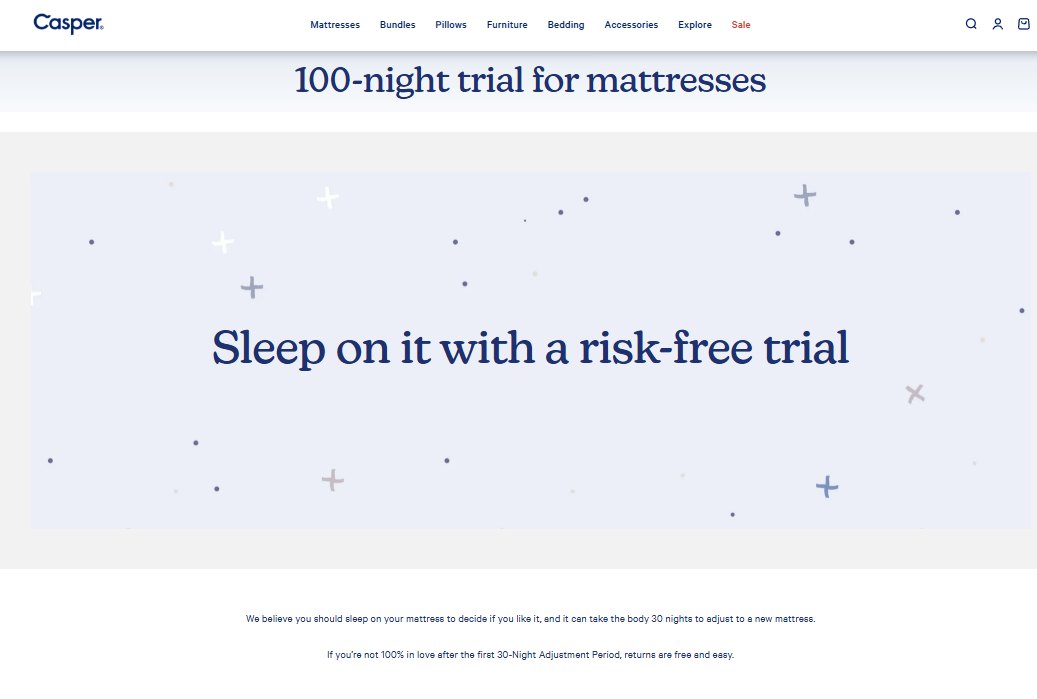
For example, Casper uses risk reversal, offering a 100-night free trial for risk-averse customers.
Three steps:
Write five different framings of your current offer (price reframe, risk reversal, urgency, social proof, outcome-first).
Hold the visual and copy constant. Only change the offer line.
Run them in parallel and track conversion rates; the click may be cheap, but the conversion is the real signal.
6. Creative Variation
One good ad rarely scales, and brands that grow profitably never bet on a single winner. They run structured variation: 10–20 versions of every concept, isolating one variable at a time so they can tell which element is doing the work.
Besides, people can get tired even of seeing good ads. On Facebook, for example, users get creative fatigue after seeing your ad four times, which is reflected in high CPC.
The Babbel app is successfully implementing creative testing to target different audiences and to reduce fatigue.
Their first ad below is more offer-led: “Lifetime Access to 14 Languages” targets deal-seekers, polyglot-curious users, or people comparing subscription value. The copy emphasizes retention and the “proven Babbel Method,” so the ICP is more rational and outcome-driven.
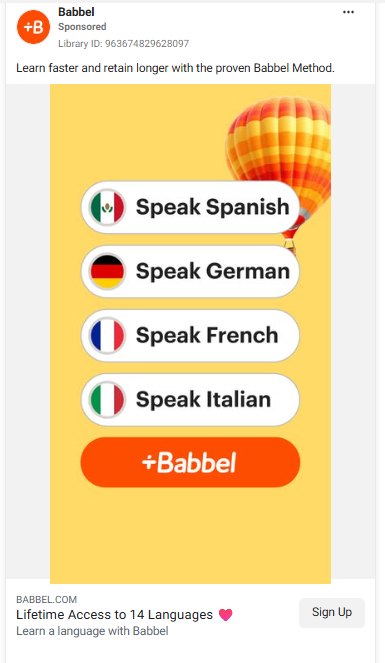
This one, however, is more confidence-led: “speak a new language in the real world” targets beginners who feel insecure using a language practically. It’s softer, more emotional, and likely aimed at casual learners needing reassurance rather than a deal.

Plus, brands using programmatic data to inform creative decisions can shorten the feedback loop significantly.
Three steps:
Plan variants before the shoot. Brief 5 hooks, 3 body angles, and 3 CTAs per concept.
Test one variable at a time. Hold everything else constant, or you can’t read the result.
Kill underperformers within 72 hours. Double down on winners with budget, not new variants.
7. Asset Type (Static, Video, Carousel)
No single asset type scales every account.
Static ads can test angles quickly.
Carousels can show product range or comparison points.
Video usually gives platforms more signals to work with in cold acquisition.
The mistake is treating format as a preference instead of a media decision.
A skincare brand, for example, may use short UGC videos to introduce a problem to cold audiences, static review cards to retarget engaged viewers, and carousel ads to compare bundles or routines before purchase.
Based on our aggregated DTC spend data, this is a useful starting point:
| Monthly Ad Spend | Static | Video | Why |
| Under $20K | 70% | 30% | Test messaging cheaply first |
| $20K–$100K | 40% | 60% | Video for cold, static for retargeting |
| $100K+ | 30% | 70% | Algorithm rewards video at scale |
These ratios are not fixed rules. A catalog-heavy fashion brand may need more static and carousel ads. A short-form-heavy beauty, fitness, or food brand may lean harder into video earlier. The point is to make asset mix intentional, then adjust based on CPA, CTR, hold rate, and conversion rate by format.
Three steps:
Map every active ad to a funnel stage. If they’re all top-of-funnel videos, you’re leaving conversion efficiency on the table.
Set a format ratio target for the next 30 days based on your spend tier.
Track CPA by format, not blended CPA, because the averages hide where the leverage is.
How Should Leaders Pressure-Test Their Creative Process?
You don’t need to read hook rates yourself. You need to know whether the people running your ads are reading them and whether they can tell an ad problem from an audience problem when performance dips.
The next time your team or agency walks you through a paid media review, ask these four questions:
| Question | What a good answer looks like |
| Is our creative refresh cadence tied to spend, or is it on a calendar? | Cadence accelerates when the budget scales. A calendar-based answer means they’re not watching fatigue curves. |
| When performance drops, can you tell me which stage of the creative caused it (hook, body, or CTA)? | They should be able to point to a specific metric (3-second view rate, hold rate, CTR) and a specific fix. |
| How many variants are we shipping per shoot? | At minimum, 5–10 modular variants per concept. One ad per shoot is a red flag. |
| Are we testing copy and visuals separately, or rolled together? | Separate. Testing them together means they can’t tell which one moved the needle. |
If the answers feel vague, the gap is usually structural.
That means creative production and media buying are running in silos, so neither side can close the loop fast enough to learn from what’s already running. Teams that combine both functions, like specialized media buying setups built around analytics-first workflows, are designed specifically to close that loop in days instead of weeks.
How Much Should You Actually Spend on Creative?
Historically, the industry rule was roughly 10% of media spend allocated to creative production, set in the TV era when one ad could run for months. That ratio has been climbing as digital fragmentation forces brands to produce more variants per channel, with industry voices like Realeyes campaigning to push it toward 20%.
For performance accounts running heavily on short-form video, where fatigue cycles are measured in days, the higher end of that range is closer to the floor than the ceiling.
Underspend creative and you fatigue faster than you can refresh, which means you end up paying for platform CPM increases instead of paying for new ads.
A practical breakdown is:
At $50K/month in media spend: $5K–$10K for creative. Enough for 2–3 UGC shoots plus a modular edit cycle. One winning concept stretched into 15–20 variants.
At $200K/month: $20K–$40K for creative. At this level, you need a content pipeline, not a campaign. Plan two refresh cycles ahead of any spend increase.
At $500K+/month: Treat creative as a permanent function, not a project. The brands sustaining this spend level have dedicated creators on retainer and ship new variants weekly.
The single most common mistake here is scaling media spend without scaling creative output.
A campaign doing 3x ROAS at $30K/month doesn’t automatically do 3x at $90K because the same five ads now have to absorb three times the impressions.
Closing Thought
Creative is the lever decision-makers actually control. Targeting, bidding, and budget allocation have all been quietly handed over to platform algorithms. What’s left is the ad itself, and the system that produces it.
The brands that scale don’t have better media buyers than everyone else. They have a creative process tied to spend, modular variants from every shoot, and a team that knows the difference between an ad problem and an audience problem before the dashboard does.
FAQ
How do I know if my agency is doing creative testing properly?
Ask them to show you a creative testing log from the last 30 days. You should see a list of variants tested, the hypothesis behind each one, and a clear winner-or-loser call within 3–7 days per test.
My ROAS is dropping, but my team says “the algorithm is fine.” Should I push back?
Yes. The algorithm is almost never the problem when ROAS drops gradually over weeks. Creative fatigue is. Ask them to pull the frequency and first-time impression ratio. If frequency is above 4 or first-time impressions are under 50%, the issue is saturation, and the answer is new creative, not new bidding.
Is AI-generated creative actually working, or is it just cheaper?
Both. AI tools dramatically lower the cost of producing variants, in some cases saving millions on ad production. This makes high-volume testing affordable for smaller brands, but the angles, hooks, and offers still need to be chosen by someone who understands the audience. Teams using AI well treat it as a way to ship 5x more variants of a human-developed concept.
What refresh cadence should I expect from an in-house team?
Depends on the platform and spend. As a rough guide: TikTok and Reels need weekly refreshes at meaningful spend levels. Meta feed can stretch to 2–4 weeks. Static ads fatigue 30–50% faster than video. If your team is refreshing monthly across the board, they’re behind the curve on at least half your channels.